
Vimarsana
Biggest News Aggregation in the World

Page 3 - Orbiting Carbon News Today : Breaking News, Live Updates & Top Stories | Vimarsana

Stay updated with breaking news from Orbiting Carbon. Get real-time updates on events, politics, business, and more. Visit us for reliable news and exclusive interviews.

Top News In Orbiting Carbon Today - Breaking & Trending Today

"Interannual variability in the Australian carbon cycle over 2015-2019," by Yohanna Villalobos, Peter J. Rayner et al. - Vimarsana News

"Interannual variability in the Australian carbon cycle over 2015-2019," by Yohanna Villalobos, Peter J. Rayner et al.

In this study, we employ a regional inverse modelling approach to estimate monthly carbon fluxes over the Australian continent for 2015-2019 using the assimilation of the total column-averaged mole fractions of carbon dioxide from the Orbiting Carbon Observatory-2 (OCO-2, version 9) satellite. Subsequently, we study the carbon cycle variations and relate their fluctuations to anomalies in vegetation productivity and climate drivers. Our 5-year regional carbon flux inversion suggests that Australia was a carbon sink averaging-0.46 ± 0.08 PgC yr-1 (excluding fossil fuel emissions), largely infl...

Source: uow.edu.au
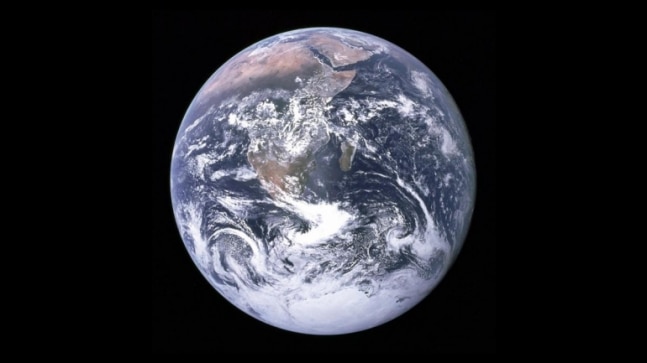
Satellites confirm people in northern hemisphere emitted less carbon dioxide in 2020 - Vimarsana News

Satellites confirm people in northern hemisphere emitted less carbon dioxide in 2020

Carbon dioxide can last in the atmosphere for up to a century after it is released, which is why short-term changes could get lost in the overall global carbon cycle.

"WOMBAT v1.0: A fully Bayesian global flux-inversion framework" by Andrew Zammit-Mangion, Michael Bertolacci et al. - Vimarsana News

"WOMBAT v1.0: A fully Bayesian global flux-inversion framework" by Andrew Zammit-Mangion, Michael Bertolacci et al.

WOMBAT (the WOllongong Methodology for Bayesian Assimilation of Trace-gases) is a fully Bayesian hierarchical statistical framework for flux inversion of trace gases from flask, in situ, and remotely sensed data. WOMBAT extends the conventional Bayesian synthesis framework through the consideration of a correlated error term, the capacity for online bias correction, and the provision of uncertainty quantification on all unknowns that appear in the Bayesian statistical model. We show, in an observing system simulation experiment (OSSE), that these extensions are crucial when the data are indeed...

Source: uow.edu.au
"Was Australia a sink or source of CO2in 2015? Data assimilation using " by Yohanna Villalobos, Peter J. Rayner et al. - Vimarsana News

"Was Australia a sink or source of CO2in 2015? Data assimilation using " by Yohanna Villalobos, Peter J. Rayner et al.

In this study, we present the assimilation of data from the Orbiting Carbon Observatory-2 (OCO-2) (land nadir and glint data, version 9) to estimate the Australian carbon surface fluxes for the year 2015. To perform this estimation, we used both a regional-scale atmospheric transport-dispersion model and a four-dimensional variational assimilation scheme. Our results suggest that Australia was a carbon sink of -0.41±0.08PgCyr-1 compared to the prior estimate 0.09±0.20PgCyr-1 (excluding fossil fuel emissions). Most of the carbon uptake occurred in northern Australia over the savanna ecotype a...

Source: uow.edu.au
COVID-19 lockdowns drive decline in active fires in southeastern United States - Vimarsana News

COVID-19 lockdowns drive decline in active fires in southeastern United States

The coronavirus pandemic, COVID-19, led to strict social-distancing guidelines that severely impacted human livelihood and economic activity. Workplace closures reduced travel, and early in spring 2020, improvements in air and water quality, reduced seismic activity, and reductions in greenhouse gas emissions were observed. COVID-19–related shutdowns emerged at the beginning of the prescribed fire season in the southeastern United States, where 80% of fires are human caused. Using active fire satellite observations and fuel treatment statistics, we estimated a 21% reduction in active fires f...

Source: pnas.org