Juno to make closest approach to Solar System's largest Moon, study Ganymede's composition, ice shells
Since its arrival in Jupiter's orbit, the spacecraft is trying to understand the origin and evolution of the planet.
Source: indiatoday.in
Stay updated with breaking news from Ultraviolet Spectrograph. Get real-time updates on events, politics, business, and more. Visit us for reliable news and exclusive interviews.
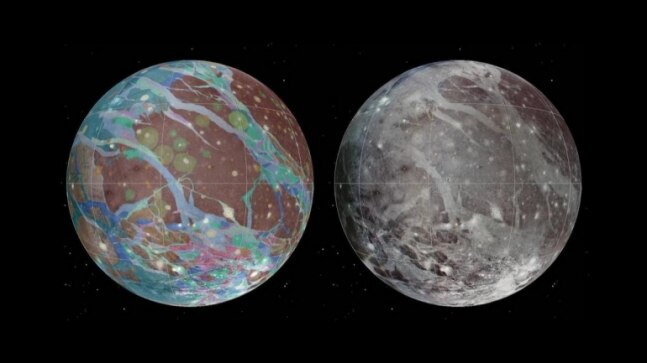
Since its arrival in Jupiter's orbit, the spacecraft is trying to understand the origin and evolution of the planet.

On June 7th, NASA's Juno will be the closest spacecraft to visit the Jupiter's largest satellite, Ganymede, since the Galileo spacecraft made a close approach more than two decades ago. It will pass within 645 miles (1,038 km) of Jupiter's moon surface, and it will make sure to document the satellite's composition, ionosphere, magnetosphere, and ice shell.
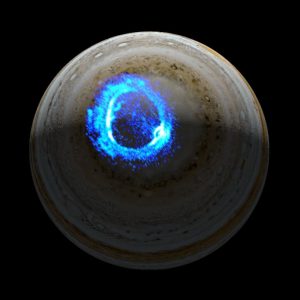
April 7, 2021 NASA’s Juno spacecraft – whose mission in orbit around Jupiter was recently extended to 2025 – has been used to discover a rapidly expanding auroral ring at the very fringes of the Jovian magnetosphere. NASA said: “In this Hubble telescope picture, a curtain of glowing gas is wrapped around Jupiter’s north pole like a lasso. This curtain of light, called an aurora, is produced when high-energy electrons race along the planet’s magnetic field and into the upper atmosphere where they excite atmospheric gases, causing them to glow. The aurora resembles the same phenomen...

Shane McGlaun - Apr 3, 2021, 10:39am CDT NASA has spacecraft orbiting planets and gathering data to help scientists learn more about our solar system. One of the spacecraft is currently operating is called Juno, and it’s in orbit around Jupiter. Juno has detected new auroral emissions on Jupiter that appear to ripple over the poles of the planet. The aurora was discovered using the Ultraviolet Spectrograph (UVS) aboard Juno. NASA says the aurora are characterized by very faint ring-shaped emissions expanding rapidly over time at speeds between two and 4.8 miles per second...

Scientists discover new auroral rings on Jupiter originating at edge of magnetosphere SwRI scientists discover a new auroral feature on Jupiter as UVS images faint auroral rings that likely originate at edge of gas giant's magnetosphere NASA Releases Photos of Jupiters Mysterious Great Red Spot The SwRI-led Ultraviolet Spectrograph (UVS) orbiting Jupiter aboard NASA's Juno spacecraft has detected new faint aurora features with ring-like emissions rapidly expanding over time. Scientists believe that charged particles coming from the edge of Jupiter's massive magnetosphere triggered these auror...