Enceladus's Fault Lines are Responsible for its Plumes
Strike-slip faults like those on Earth are responsible for Enceladus' plumes, according to new research. Tidal forces open and close them.
Source: universetoday.com
Stay updated with breaking news from Berne. Get real-time updates on events, politics, business, and more. Visit us for reliable news and exclusive interviews.

Strike-slip faults like those on Earth are responsible for Enceladus' plumes, according to new research. Tidal forces open and close them.
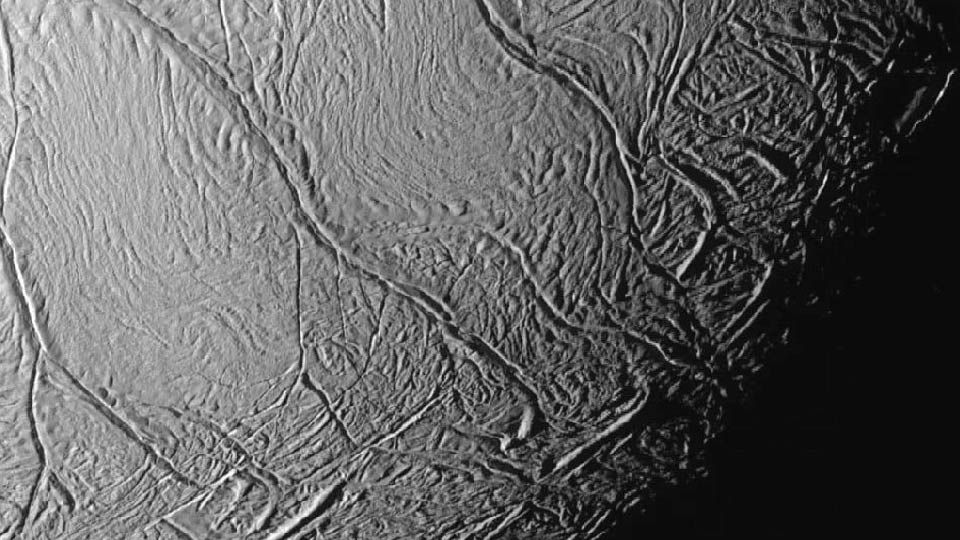
Huge "tiger stripe" fault lines seen on Saturn's moon Enceladus raise hopes that a "long-lived" ocean containing potential alien life may lurk beneath the moon's icy shell.

(NEW YORK) — In the race to understand the potential habitability of Saturn’s icy and active moon, Enceladus, scientists could have a newfound understanding of the moon’s defining stripes and eruptions. Enceladus harbors a global, subsurface ocean more than 30 miles deep, that periodically erupts […]
NASA/JPL-Caltech/Space Science Institute(NEW YORK) -- In the race to understand the potential habitability of Saturn's icy and active moon, Enceladus, scientists could have a newfound understanding of the moon's defining stripes and eruptions.Enceladus harbors a global, subsurface ocean more than 30 miles deep, that periodically erupts jets of ice crystals and plumes of gas above its South Pole, which were first recognized by NASA's Cassini spacecraft in 2005.During the 13-year mission studying Saturn and its 146 moons, the Cassini spacecraft was able to capture material ejected into space by ...
NASA/JPL-Caltech/Space Science Institute(NEW YORK) -- In the race to understand the potential habitability of Saturn's icy and active moon, Enceladus, scientists could have a newfound understanding of the moon's defining stripes and eruptions.Enceladus harbors a global, subsurface ocean more than 30 miles deep, that periodically erupts jets of ice crystals and plumes of gas above its South Pole, which were first recognized by NASA's Cassini spacecraft in 2005.During the 13-year mission studying Saturn and its 146 moons, the Cassini spacecraft was able to capture material ejected into space by ...