Quantum-limited optical time transfer for future geosynchronous links
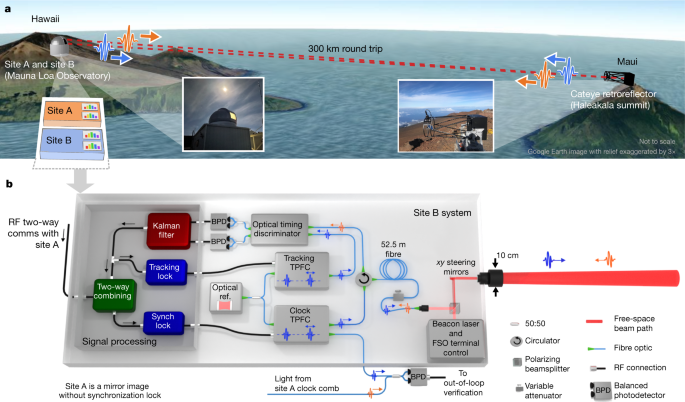
The combination of optical time transfer and optical clocks opens up the possibility of large-scale free-space networks that connect both ground-based optical clocks and future space-based optical clocks. Such networks promise better tests of general relativity1–3, dark-matter searches4 and gravitational-wave detection5. The ability to connect optical clocks to a distant satellite could enable space-based very long baseline interferometry6,7, advanced satellite navigation8, clock-based geodesy2,9,10 and thousandfold improvements in intercontinental time dissemination11,12. Thus far, only...
Source: nature.com