Vimarsana
Biggest News Aggregation in the World

Page 3 - Transformative Bio Molecules News Today : Breaking News, Live Updates & Top Stories | Vimarsana

Stay updated with breaking news from Transformative Bio Molecules. Get real-time updates on events, politics, business, and more. Visit us for reliable news and exclusive interviews.

Top News In Transformative Bio Molecules Today - Breaking & Trending Today

Resetting the biological clock -- Science & Technology -- Sott.net - Vimarsana News

Resetting the biological clock -- Science & Technology -- Sott.net

Simple Science Summary The cells in our body follow a 24-hour cycle, the circadian clock. Disruptions of this cycle, for example by working night shifts, can cause disease. In recent years, it has become clear that the clock can be disrupted in...

Source: sott.net
Light-controlled on/off switch helps control biological clock in cultured cells, explanted tissue - Vimarsana News

Light-controlled on/off switch helps control biological clock in cultured cells, explanted tissue

Light-controlled on/off switch helps control biological clock in cultured cells, explanted tissue The biological clock is present in almost all cells of an organism. As more and more evidence emerges that clocks in certain organs could be out of sync, there is a need to investigate and reset these clocks locally. Scientists from the Netherlands and Japan introduced a light-controlled on/off switch to a kinase inhibitor, which affects clock function. This gives them control of the biological clock in cultured cells and explanted tissue. They published their results on 26 May in Nature Communi...

Resetting the biological clock by flipping a switch - Vimarsana News

Resetting the biological clock by flipping a switch

 E-Mail IMAGE: Reversible modulation of the circadian clock using chronophotopharmacology. Using light to interconvert two isomers of a photo-responsive small molecule, it is possible to pace cellular time. While irradiation with violet... view more  Credit: Issey Takahashi The biological clock is present in almost all cells of an organism. As more and more evidence emerges that clocks in certain organs could be out of sync, there is a need to investigate and reset these clocks locally. Scientists from the Netherlands and Japan introduced a light-controlled on/off switch to a kinase...

Nagoya University scientists reveal unprecedentedly versatile new DNA staining probe - Vimarsana News

Nagoya University scientists reveal unprecedentedly versatile new DNA staining probe

 E-Mail IMAGE: Allowing discrimination between organelle DNA using low phototoxicity visible light, Kakshine offers easy imaging even with cutting edge microscopy techniques. view more  Credit: Yoshikatsu Sato A group of scientists at Nagoya University, Japan, have developed an incredibly versatile DNA fluorescent dye, named 'Kakshine' after a former NU student of its members, Dr Kakishi Uno, but it also means to make the nucleus shine brightly, since the nucleus is pronounced 'Kaku' in Japanese. Dr Uno, with Dr Yoshikatsu Sato and Nagisa Sugimoto, the other two members of the resea...

Nanotechnology Now - Press Release: 3D design leads to first stable and strong self-assembling 1D nanographene wires - Vimarsana News

Nanotechnology Now - Press Release: 3D design leads to first stable and strong self-assembling 1D nanographene wires

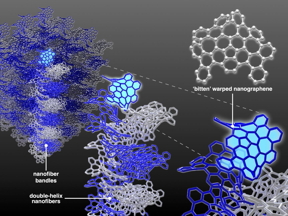
Home > Press > 3D design leads to first stable and strong self-assembling 1D nanographene wires Schematic illustration of hierarchical structures of carbon nanofiber bundles made of bitten warped nanographene molecules. CREDIT NINS/IMS Abstract: Nanographene is flexible, yet stronger than steel. With unique physical and electronic properties, the material consists of carbon molecules only one atom thick arranged in a honeycomb shape. Still early in technological development, current fabrication methods require the addition of substituents to obtain a uniform material. Additive-free methods re...