Vimarsana
Biggest News Aggregation in the World

Page 6 - Solid Earth News Today : Breaking News, Live Updates & Top Stories | Vimarsana

Stay updated with breaking news from Solid Earth. Get real-time updates on events, politics, business, and more. Visit us for reliable news and exclusive interviews.

Top News In Solid Earth Today - Breaking & Trending Today

Moon-forming impactor as a source of Earth's basal mantle anomalies - Vimarsana News

Moon-forming impactor as a source of Earth's basal mantle anomalies

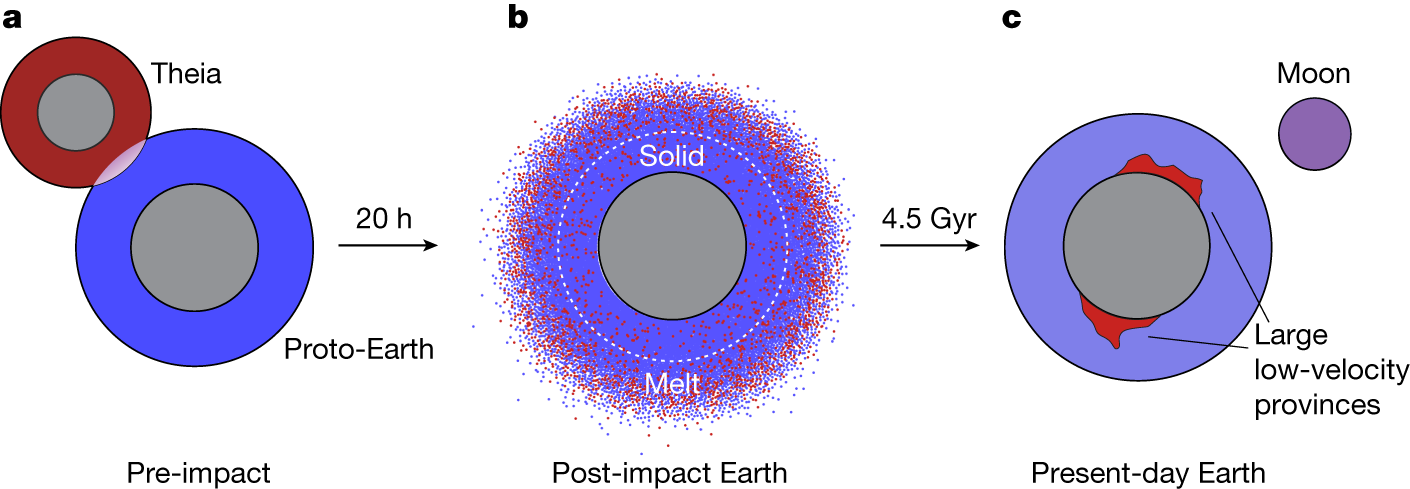
Seismic images of Earth’s interior have revealed two continent-sized anomalies with low seismic velocities, known as the large low-velocity provinces (LLVPs), in the lowermost mantle1. The LLVPs are often interpreted as intrinsically dense heterogeneities that are compositionally distinct from the surrounding mantle2. Here we show that LLVPs may represent buried relics of Theia mantle material (TMM) that was preserved in proto-Earth’s mantle after the Moon-forming giant impact3. Our canonical giant-impact simulations show that a fraction of Theia’s mantle could have been deli...

Source: nature.com
A super-massive Neptune-sized planet - Vimarsana News

A super-massive Neptune-sized planet

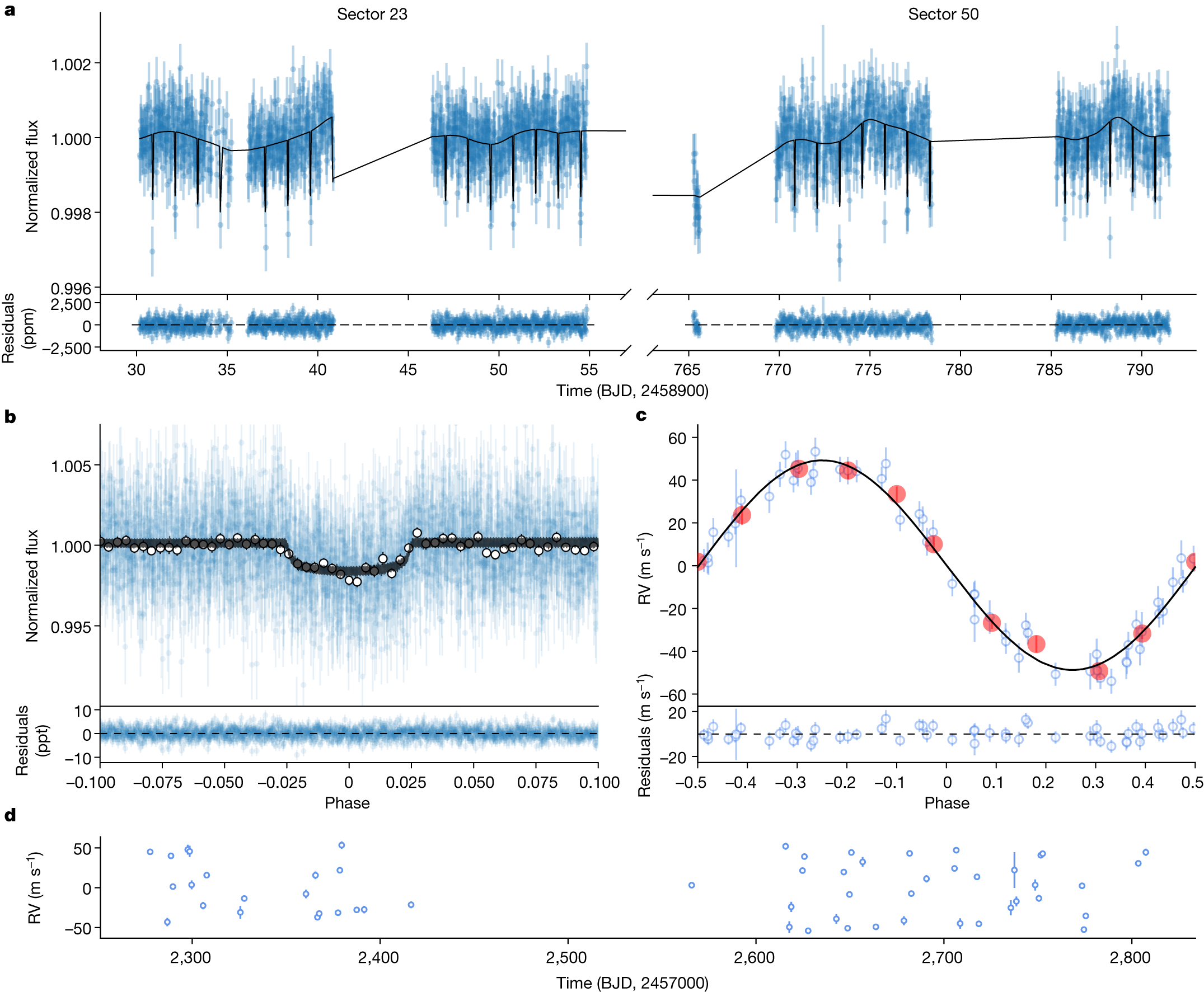
Neptune-sized planets exhibit a wide range of compositions and densities, depending on factors related to their formation and evolution history, such as the distance from their host stars and atmospheric escape processes. They can vary from relatively low-density planets with thick hydrogen–helium atmospheres1,2 to higher-density planets with a substantial amount of water or a rocky interior with a thinner atmosphere, such as HD 95338 b (ref. 3), TOI-849 b (ref. 4) and TOI-2196 b (ref. 5). The discovery of exoplanets in the hot-Neptune desert6, a...

Source: nature.com
A planetary collision afterglow and transit of the resultant debris cloud - Vimarsana News

A planetary collision afterglow and transit of the resultant debris cloud

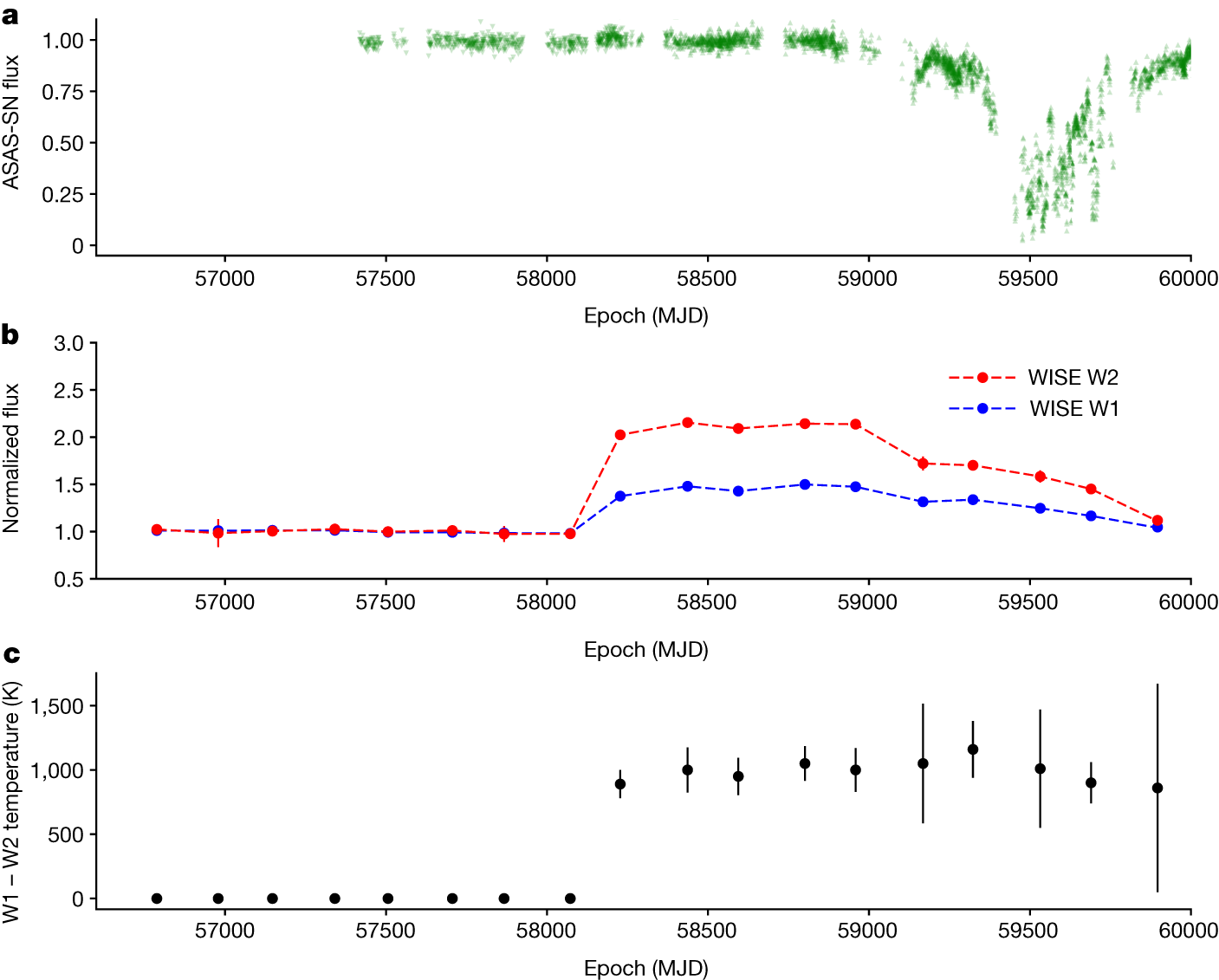
Planets grow in rotating disks of dust and gas around forming stars, some of which can subsequently collide in giant impacts after the gas component is removed from the disk1–3. Monitoring programmes with the warm Spitzer mission have recorded substantial and rapid changes in mid-infrared output for several stars, interpreted as variations in the surface area of warm, dusty material ejected by planetary-scale collisions and heated by the central star: for example, NGC 2354–ID8 (refs. 4,5), HD 166191 (ref. 6) and V488 Persei7. Here we report combined observations of the ...

Source: nature.com
New Multi-institution Earthquake Center Aims To Advance Understanding Of Cascadia Subduction Zone - Vimarsana News

New Multi-institution Earthquake Center Aims To Advance Understanding Of Cascadia Subduction Zone

Oregon State University researchers will play key roles in a new multi-institution earthquake research center dedicated to the study of the Pacific Northwest’s Cascadia Subduction...

What are these strange lights and why they appear before earthquake? - Vimarsana News

What are these strange lights and why they appear before earthquake?

It has been nearly a week since the devastating 6.8 earthquake shook Morocco to its core killing more than 2,900 people and leaving more than 3,000 others injured, as rescuers are continuing to...