Vimarsana
Biggest News Aggregation in the World

Page 2 - Galaxy Formation News Today : Breaking News, Live Updates & Top Stories | Vimarsana

Stay updated with breaking news from Galaxy Formation. Get real-time updates on events, politics, business, and more. Visit us for reliable news and exclusive interviews.

Top News In Galaxy Formation Today - Breaking & Trending Today

Scientists Befuddled by Impossible Galaxy Seen by James Webb - Vimarsana News

Scientists Befuddled by Impossible Galaxy Seen by James Webb

Astronomers using the James Webb Space Telescope (JWST) have discovered a massive galaxy that's so old its existence should be impossible, posing a challenge to current theoretical models on dark matter. As detailed in a new study published in the journal Nature, the so-called quiescent galaxy, ZF-UDS-7329, contains more stars than the Milky Way — […]

Source: yahoo.com

Webb Can Directly Test One Theory for Dark Matter - Vimarsana News

Webb Can Directly Test One Theory for Dark Matter

Dark matter played a role in early galaxy formation and it may have been affected by supersonic interactions witih regular matter.

Black holes existed at the dawn of time, birthing new stars, finds study - Vimarsana News

Black holes existed at the dawn of time, birthing new stars, finds study

A new study suggests that supermassive black holes existed in the earliest days of the universe, upending current theories about star formation and galaxy creation.

Galaxy formation mysteries solved: Black holes as stellar catalysts - Vimarsana News

Galaxy formation mysteries solved: Black holes as stellar catalysts

Recent analysis of data collected by the James Webb Space Telescope has shattered our previous understanding of the universe

Source: theweek.in
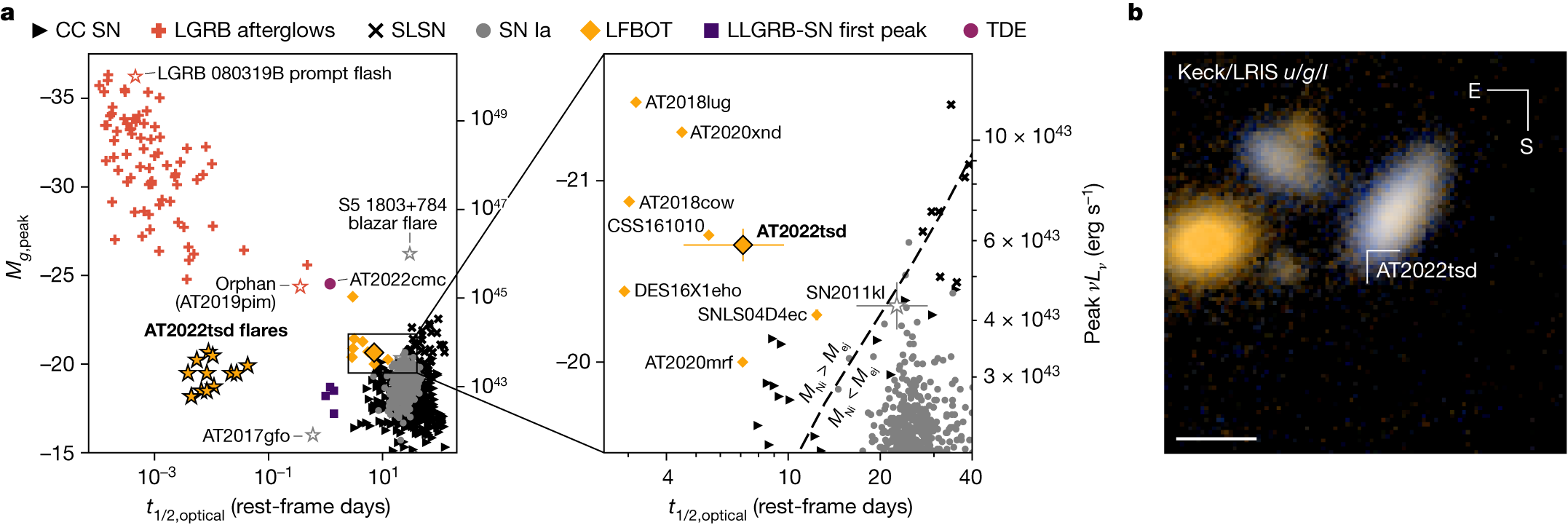
Minutes-duration optical flares with supernova luminosities - Vimarsana News

Minutes-duration optical flares with supernova luminosities

In recent years, certain luminous extragalactic optical transients have been observed to last only a few days1. Their short observed duration implies a different powering mechanism from the most common luminous extragalactic transients (supernovae), whose timescale is weeks2. Some short-duration transients, most notably AT2018cow (ref. 3), show blue optical colours and bright radio and X-ray emission4. Several AT2018cow-like transients have shown hints of a long-lived embedded energy source5, such as X-ray variability6,7, prolonged ultraviolet emission8, a tentative X-ray quasiperiodic o...

Source: nature.com