Vimarsana
Biggest News Aggregation in the World

Page 6 - Robert Dicke News Today : Breaking News, Live Updates & Top Stories | Vimarsana

Stay updated with breaking news from Robert Dicke. Get real-time updates on events, politics, business, and more. Visit us for reliable news and exclusive interviews.

Top News In Robert Dicke Today - Breaking & Trending Today

Physics - Finding Light in Dark Atomic Clouds - Vimarsana News

Physics - Finding Light in Dark Atomic Clouds

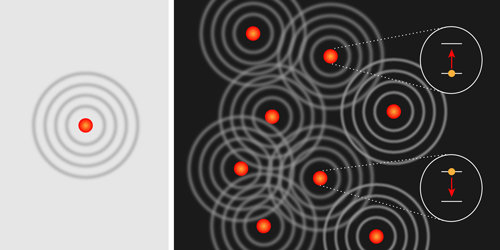
Finding Light in Dark Atomic Clouds May 10, 2021• Physics 14, 69 Researchers have prepared and manipulated subradiant states—in which collective effects slow down the decay of excited atoms—in a dense atomic cloud. Figure 1: (Left) An atom in an excited state eventually—unavoidably—decays to its ground state, releasing a photon. (Right) In a collection of excited atoms separated by less than the transition wavelength, destructive interference in their photon emission prevents their collective decay from the excited state ( e) to the ground state ( g).(Left) An atom in an exci...

Source: aps.org
Black Holes in the Time of Coronavirus - Vimarsana News

Black Holes in the Time of Coronavirus

Black holes are prisons of light. They are both metaphor and physical entity, mute commentary on what is known, unknown, and unknowable. Well-studied but poorly understood, like a virus. What happens gravitationally if you squeeze the mass of an object to a point? This was Karl Schwarzschild’s question while stationed at the Russian front of the First World War. You get a point of no volume and infinite density — a singularity. It would be surrounded by a region where nothing, not even light, could escape. This boundary became known as the event horizon because no event within the boundar...

This Month in Physics History - Vimarsana News

This Month in Physics History

This Month in Physics History January 1965: Roger Penrose’s Seminal Proof of Blackholes The eminent physicist Roger Penrose won the 2020 Nobel Prize in Physics “for the discovery that black hole formation is a robust prediction of the general theory of relativity,” sharing the prize with Reinhard Genzel and Andrea Ghez, “for the discovery of a supermassive compact object at the center of our galaxy.” But the rough concept of a black hole dates back to the 18th century, before Albert Einstein had even formulated his general theory of relativity and before Penrose's discovery in 1965....

Source: aps.org
