How Earthquakes Grow from a Tiny Fracture to a Catastrophic Event
State-of-art numerical simulations illustrate how a small-scale shear instability can become a giant earthquake in a manner that is consistent with seismological observation.
Stay updated with breaking news from Solid Earth. Get real-time updates on events, politics, business, and more. Visit us for reliable news and exclusive interviews.
State-of-art numerical simulations illustrate how a small-scale shear instability can become a giant earthquake in a manner that is consistent with seismological observation.
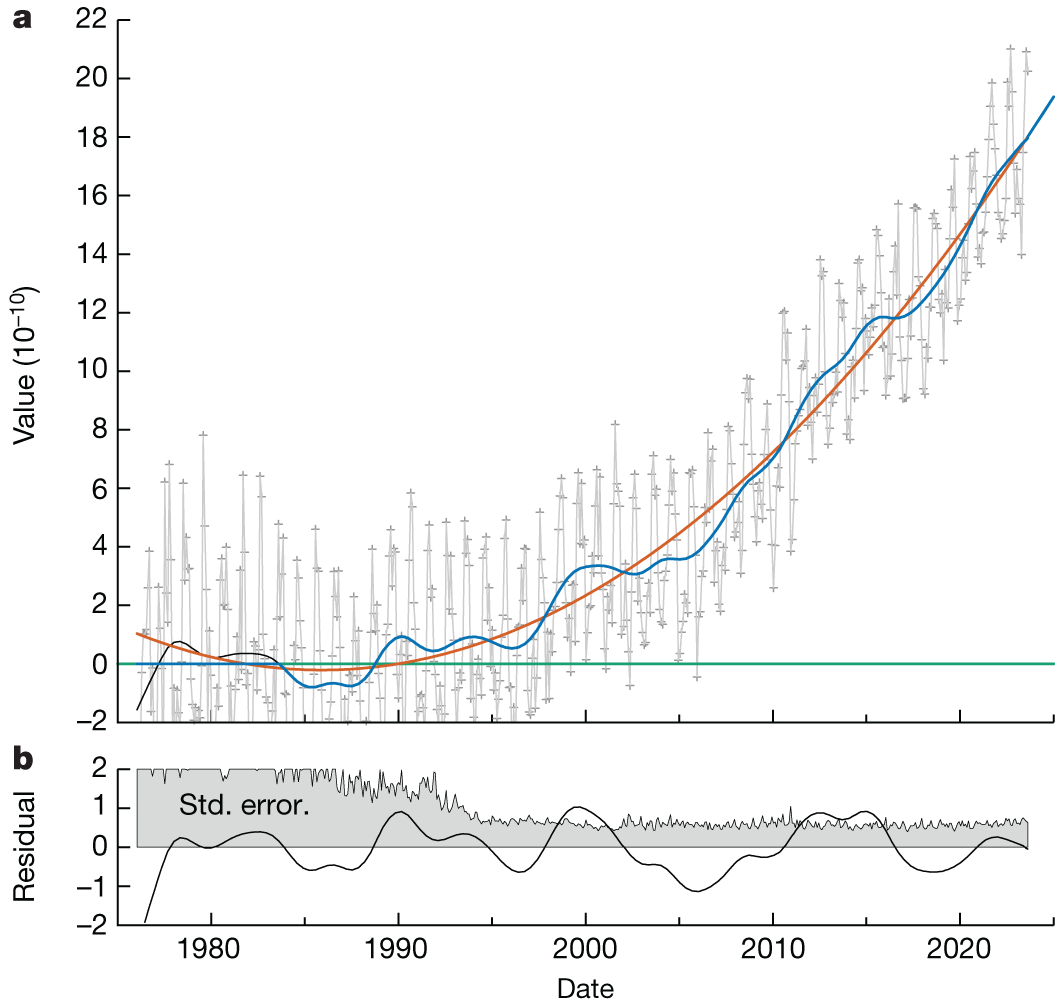
The historical association of time with the rotation of Earth has meant that Coordinated Universal Time (UTC) closely follows this rotation1. Because the rotation rate is not constant, UTC contains discontinuities (leap seconds), which complicates its use in computer networks2. Since 1972, all UTC discontinuities have required that a leap second be added3. Here we show that increased melting of ice in Greenland and Antarctica, measured by satellite gravity4,5, has decreased the angular velocity of Earth more rapidly than before. Removing this effect from the observed angular velocity shows tha...

New seafloor magnetic data help scientists retrace the evolution of the Reykjanes Ridge, lending insights into the effects of a mantle plume on mid-ocean ridge organization and evolution.
Learn about the person taking the helm of JGR: Solid Earth and his vision for the coming years.
The outgoing Editor-in-Chief of JGR: Solid Earth reflects on their tenure and expresses appreciation to all those who contributed to the success of the journal over recent years.